
Dominus Gladiatus Money Guide: Income & Upkeep
Dominus Gladiatus money guide: the 1+1 upkeep formula, arena purses, exhibition income, staff costs, taxes, debt and the reserve that keeps a Ludus alive.
Dominus Gladiatus is a coin-flow game disguised as a combat game. Every gladiator adds 1 coin per day to upkeep, every building and staff hire is a lump sum, and every arena purse has a recovery cost attached. A roster that looks affordable on the day you buy it can be bankrupt by the next market refresh.
Quick answer
Keep the roster at 2-3 fighters until arena income supports more, take purses that cover at least one recovery cycle, and hold a 30-50 coin reserve in the opening. Post-game contract batches raise upkeep, so the same roster becomes more expensive over time. Debt is survivable but it removes your margin for error.
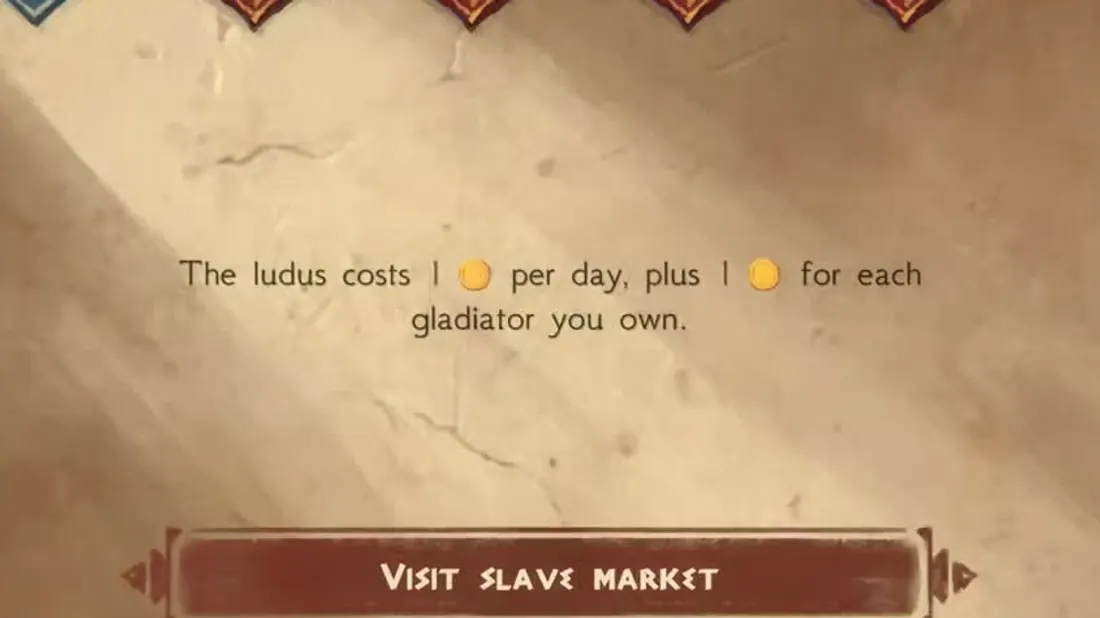
What is the exact upkeep formula?
The GENERAL tab states: "The ludus costs 1 coin per day, plus 1 coin for each gladiator you own."
Examples:
| Gladiators | Daily upkeep |
|---|---|
| 1 | 2 |
| 2 | 3 |
| 3 | 4 |
| 4 | 5 |
| 5 | 6 |
Staff, building usage, equipment and healing are separate costs. The formula is the floor, not the full burn.
Over 30 days, a three-gladiator Ludus pays 120 coins in base upkeep. That is more than a Palus (60) plus a Doctore (80) combined, which is why roster size is the first economic decision.
Official source: Dominus Gladiatus store page ↗
What are the income channels?
| Channel | Typical value | Risk |
|---|---|---|
| Arena purse | 20-70 coins; beast spectacles higher | Fatigue, injury, death |
| Exhibition match | 20 base + 3 per arena victory | Low, but cooldown-limited |
| Contracts (post-game) | Batch-dependent | Rising upkeep, To-the-Death |
| Selling a gladiator | Market-dependent | Loses training investment |
| Venator commodities | Variable | Uses a gladiator's time |
The arena is the main income. Exhibitions are a top-up. Selling is a last resort, not a business model.
The purses I saw in the full-run footage ranged from 20 coins for a small bout to 70 for a standard arena fight and 200 for a lion spectacle. Treat those as examples; the card is the authority.
How do you calculate a good purse?
Compare the purse with the recovery cost, not with the number alone.
A simple formula:
Net value = purse - (recovery days x daily upkeep) - (injury probability x Infirmary cost) - (death probability x replacement cost)
You do not need exact probabilities. The formula forces the right questions:
- How many days will this fighter be unavailable after the fight?
- What does the Ludus spend per day while they recover?
- Can I replace them if they die?
A 70-coin purse at Fatigue 2 with a safe matchup is excellent. The same purse at Fatigue 4 with a 50% injury chance is a trap.
What should you spend coins on first?
Priority order for a healthy run:
- Daily upkeep. Never miss it; debt compounds.
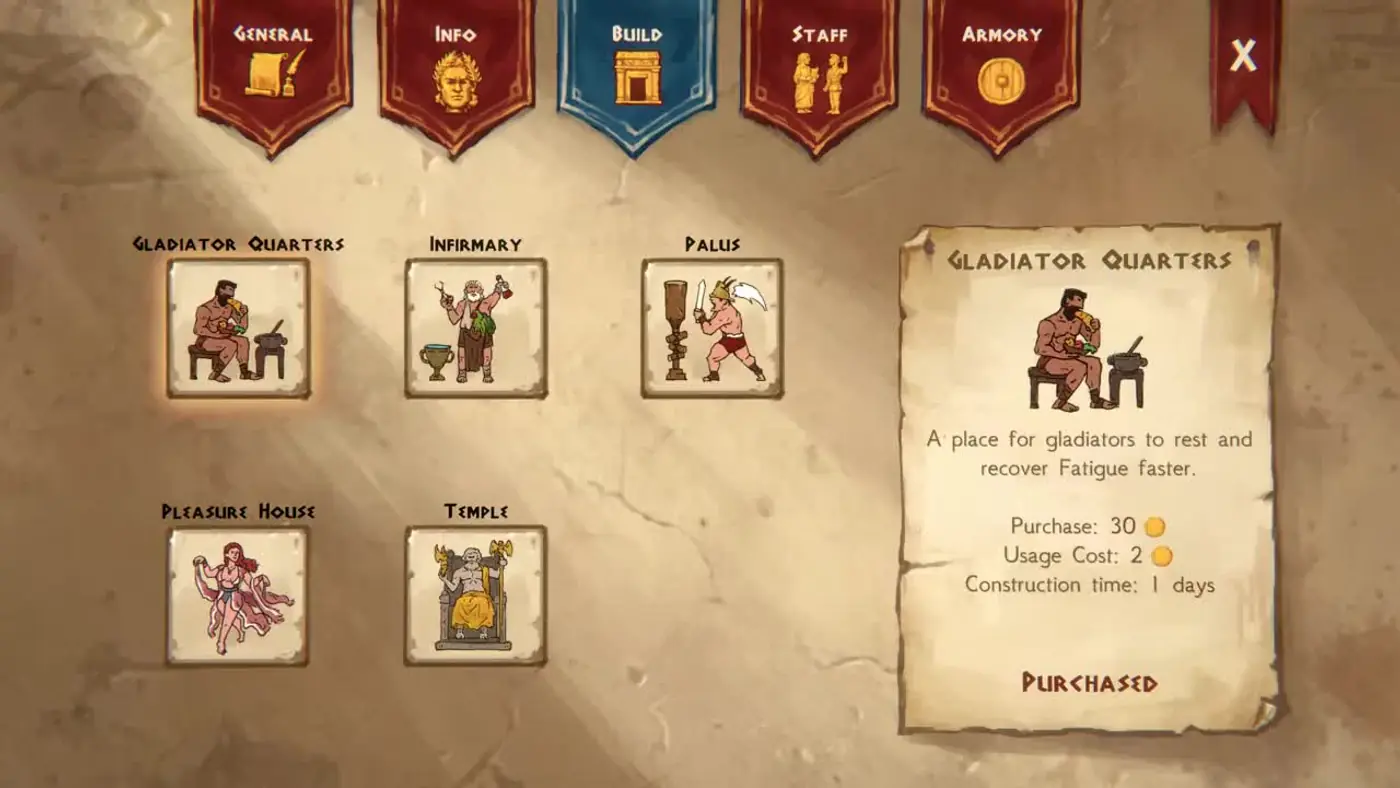
- Gladiator Quarters (30). Fatigue recovery is the cheapest insurance.
- Palus (60). Training speed compounds across the roster.
- Doctore (80). Hire when training is continuous.
- Infirmary. Build when the first injury lands.
- Weapon/shield for the main fighter. Only after the recovery and training core.
- Pleasure House. Morale insurance before high-risk contracts.
- Faber. Equipment insurance for To-the-Death fights.
Do not buy a 75-coin weapon before the Quarters. The weapon helps one fight; the Quarters helps every fight.
How do taxes and debt work?
Cassius Lysandros can impose taxes that push you into debt instead of forcing an immediate forfeit, according to the Day 1 notes. Debt is not a game over, but it is a warning that the daily margin is negative.
When debt appears:
- Stop all non-essential purchases.
- Sell a weak or duplicate gladiator.
- Take only safe, high-value purses.
- Reduce the roster to the fighters who actually earn.
- Do not hire new staff until the balance is positive.
Debt plus a long injury is the combination that ends runs. The reserve exists to prevent that pairing.
How do exhibitions fit the economy?
Patch 7 set the exhibition base reward at 20 coins, plus 3 coins for each arena victory. The Ordinator manages exhibitions after Patch 6.
Exhibitions are useful when:
- A new recruit needs experience without a dangerous purse.
- Your main fighters are resting but you want some income.
- You are between contract batches and want to keep the roster sharp.
They are not a replacement for arena purses. A 20-coin exhibition cannot cover a 4-coin daily upkeep plus an Infirmary stay.
What changes after the Grand Tournament?
Each post-game contract batch raises Ludus upkeep according to the Day 1 notes. The roster that was affordable at day 160 may be too expensive at day 200.
Post-game money rules:
- Build the roster for the contract sizes you actually accept.
- Do not keep five gladiators for occasional 5v5s; the daily cost is permanent.
- Price beast spectacles against the replacement cost of the fighter, not just the purse.
- Keep a reserve for at least one full healing cycle.
- Recheck the daily margin after every batch.
The endgame contracts guide → covers the batch economy in detail.
A sample daily margin
A three-gladiator Ludus with the Quarters and Palus:
| Item | Coins per day |
|---|---|
| Base upkeep (1 + 3) | 4 |
| Quarters usage (occasional) | 0-2 |
| Training/staff amortised | 0-3 |
| Total burn | 4-9 |
| One 40-coin purse every 3 days | +13 average |
| Net | +4 to +9 |
This is why the early game feels tight: a single 40-coin purse every three days barely covers a modest roster. The margin comes from winning consistently and avoiding injuries, not from finding a secret high-purse contract.
Official source: Dominus Gladiatus patch notes ↗
Official source: Steam achievements ↗
FAQ
What happens if I run out of coins? Cassius's tax can push you into debt rather than ending the run immediately. Sell a gladiator or cut the roster to restore a positive margin.
Should I sell gladiators for money? Only when the fighter is a duplicate or a long-term injury. Selling a trained earner costs more in replacement time than it saves.
Is the arena the only income? No. Exhibitions, contracts, Venator commodities and selling gladiators are secondary channels. Arena purses remain the main one.
Does upkeep rise over time? The base formula stays 1 + 1 per gladiator, but post-game contract batches raise Ludus upkeep according to the Day 1 notes.
More Dominus Gladiatus Guides
A Dominus Gladiatus arena readiness checklist: Fatigue, injuries, Health, morale, crowd, matchup, rules and reserve before you accept a purse.
Dominus Gladiatus best build guide: Health vs damage, skill order for Murmillo, Secutor and Scissor, Veteran bonuses, equipment priorities and team-fight roles.
Dominus Gladiatus best gladiators tier list: Health, talents, temperament and class value, plus when to buy, keep or sell a recruit from the Slave Market.
Dominus Gladiatus class guide: Murmillo, Secutor and Scissor strengths, skill synergies, Retiarius and Hoplomachus matchups, and the best first class.
How crowd favor works in Dominus Gladiatus: Liked, Indifferent and Disliked calls, two calls per fight, stones and food, favored immunity and Ruthless rules.
All six Dominus Gladiatus Domini: Titus Aurelian, Khepri Setekh, Cassius Lysandros, Aurelia Zahara, Livia Calpurnia and Decimus Amborix, powers and counterplay.
Twelve Dominus Gladiatus tips that prevent early run deaths: fatigue management, market discipline, morale warnings, crowd calls and upkeep traps.
Dominus Gladiatus equipment guide: weapon, shield, helmet, legs, armband and pants stats, block chance vs damage reduction, weapon range and spending priority.